
Utilities · Canada
How to Read EnerGuide Labels on Appliances in Canada Before You Buy

To read an EnerGuide appliance label in Canada, look at the big kWh-per-year number, compare it only against models of the same type and size, then multiply it by your electricity rate to get a yearly running cost. Lower kWh is better for appliances, and the pointer on the scale only means something inside the same class.
Shoppers compare the red sale tag and ignore the black-and-white EnerGuide hang-tag that will still be on the Visa in year eight. For appliances, the big number is kWh per year under a test cycle — consumption, not an efficiency percent. Lower is better. The pointer only means something inside the same type and capacity class.
This is the product label, not the house rating. The home evaluation is a different EnerGuide: what a blower-door visit includes. Convert fuels and ¢ in useful-heat math if the appliance is a dryer or water heater on the heating bill.
Key takeaways
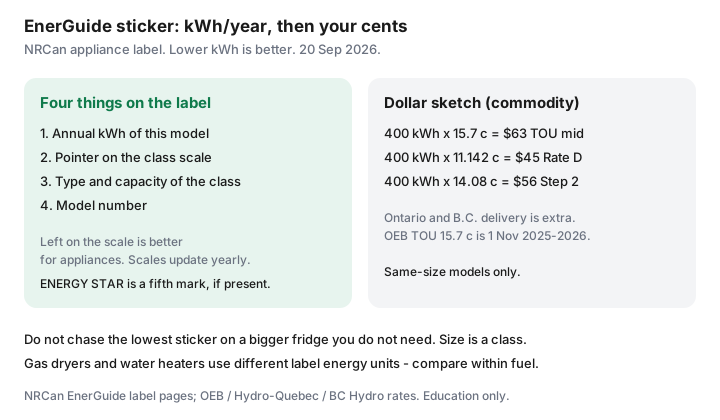
- NRCan’s appliance label shows four things: annual kWh, a pointer on the class scale, the type and capacity that define the class, and the model number. ENERGY STAR, if present, is an extra mark — not a substitute for kWh/year.
- For appliances, lower kWh is better and further left on the scale is better. For many heating and cooling products, the rating is an efficiency number and higher / further right is better. Do not mix the two habits.
- Compare same-size, same-defrost, same-configuration fridges — not a 14 cu. ft. against a French-door 25.
- Dollars ≈ kWh/year × your all-in ¢. Sketch using OEB TOU mid-peak 15.7 ¢ (1 Nov 2025–31 Oct 2026), Hydro-Québec Rate D second tier 11.142 ¢ (1 Apr 2026), or BC Hydro Step 2 14.08 ¢ — plus delivery where it applies.
- A larger “efficient” unit can still use more kWh than a smaller ordinary one. Buy the size you will fill, then the left-side pointer.
What does the kWh/year number mean on fridges, washers and more?
It is the estimated electricity the appliance uses in a year under a standard test. Lower is better, but only when you compare models of the same type and capacity.
NRCan’s “reading the label” page (as of 20 Sep 2026) is the method. The large number is estimated annual electricity use in kilowatt-hours under a standardized test — not your leftover-packed fridge, not a cold garage, not 14-minute showers. It lets models compete. It does not invoice your LDC.
The scale is the range of similar models sold in Canada. Labelling scales for appliances are released annually (NRCan: January for appliances, March for room air conditioners). A pointer outside the bar can appear when a new model lands after the scale was printed. Check type and capacity printed on the label so you are not comparing a compact fridge to a side-by-side.
How do you compare similar-size models fairly?
A 280 kWh compact and a 480 kWh family fridge can both sit “left of centre” in their own classes. The family fridge still uses more electricity. Choose capacity from how you shop (and whether the garage fridge is a second always-on load), then pick the better kWh inside that class.
You may see a Canadian EnerGuide tag and a U.S. yellow EnergyGuide on the same hang-tag. Test methods are often similar; the scale can differ because the model mix differs. Use the Canadian kWh and the Canadian class for a Canadian bill.
How do labels differ for electric vs gas dryers and water heaters?
| Product | What the Canadian label is doing | Shopping rule |
|---|---|---|
| Fridge, freezer, washer, dishwasher, electric dryer | kWh/year; lower is better | Same configuration and size; then the left-side pointer |
| Gas dryer / gas range | Different or limited labelling (gas ranges: EnerGuide is not mandatory) | Compare gas to gas. A “cheap electric dryer” on Rate D second tier is a winter habit, not a bargain |
| Water heaters | Electric models in kWh-style energy use; gas models in a fuel-energy figure | Pick the fuel you already have, then efficiency. A fuel switch is a venting and panel project |
| Room A/C / some heating equipment | Often an efficiency metric — higher can be better | Read the product-type instructions on the NRCan page; do not reuse the fridge habit |
How do you turn kWh/year into dollars on your utility bill?
Multiply the label’s kWh/year by your electricity price per kWh. Add delivery charges where your utility bills them separately.
Example with made-up inputs: a commodity sketch for 400 kWh/year (a modern fridge-class ballpark, not a rating), using rates as of 9 Oct 2026:
- Ontario TOU mid-peak 15.7 ¢ (1 Nov 2025–31 Oct 2026) → about $63 commodity. Off-peak 9.8 ¢ is about $39; on-peak 20.3 ¢ is about $81. Always-on loads mix all three. Delivery and the 23.5% OER sit on top / beside that.
- Hydro-Québec Rate D second tier 11.142 ¢ (1 Apr 2026) → about $45. A house already over 40 kWh/day in January lives here.
- BC Hydro Step 2 14.08 ¢ → about $56 energy, plus the daily basic charge. Step 1 11.87 ¢ is about $47 if you still have room in the step.
A 200 kWh/year gap between two same-size fridges is about $20–$40 a year at those commodity ¢ — real money over a 12-year life, rarely enough to justify a $400 price jump by itself. Combine it with the sale price and whether you are retiring a 1998 unit that was never labelled this way.
When does a larger efficient unit still cost more to run?
French-door, through-the-door ice, and a second freezer drawer add kWh even when the pointer looks “good” for that luxury class. A 25 cu. ft. ENERGY STAR can beat its 25 cu. ft. peers and still lose to an 18 cu. ft. ordinary fridge. Buy the box you will fill. An empty extra fridge in the basement is a dedicated space heater that makes leftovers.
Washers: kWh/year assumes a test cycle. Your hot-water washer on an electric tank is also a water-heater bill. Cold wash is the Canadian habit that the sticker cannot force.
Should you recycle an old second fridge?
The win is often retiring the second fridge, not buying a slightly better first fridge. Utilities and provinces run pick-up / recycling offers that open and close (Save on Energy, BC Hydro fridge take-back, municipal hazardous-waste days). Confirm the live bounty and whether the appliance must still power on. Do not pay a junk guy to dump a refrigerant appliance in a ravine.
LEDs in the same store aisle are a faster kWh cut than a range upgrade. If a recessed can is still halogen, you are heating the attic on purpose — upgrade order.
Sources
- NRCan, Reading the EnerGuide label — four appliance fields; lower kWh better; left on the scale better; compare type and capacity (as of 20 Sep 2026).
- NRCan, EnerGuide label for appliances and room air conditioners — annual scale updates (January appliances, March room A/C).
- OEB RPP 1 Nov 2025–31 Oct 2026 — TOU 9.8 / 15.7 / 20.3 ¢; 23.5% OER.
- Hydro-Québec Rate D 1 Apr 2026 — 7.065 ¢ first 40 kWh/day, 11.142 ¢ second tier (as of 9 Oct 2026); BC Hydro residential tiered rate (RS 1101) Step 1 / Step 2 11.87 / 14.08 ¢ plus a 23.44 ¢/day basic charge (as of 9 Oct 2026).
Frequently asked questions
Is a lower EnerGuide number always more efficient?
For appliances, lower kWh/year means lower tested consumption. It is not a percentage efficiency. Compare inside the same class.
Why is the U.S. yellow label different?
Canada and the U.S. often use similar tests; the scale can differ because the mix of models differs. Use the Canadian kWh for a Canadian bill.
How do I turn kWh into dollars?
Multiply kWh/year by your all-in ¢ (commodity plus, in most provinces, a delivery share). The article’s 15.7 ¢ / 11.142 ¢ / 14.08 ¢ sketches are commodity illustrations.
Should I replace a working fridge to save energy?
Only if it is old, loud, and you will recycle it — or you are killing a second garage fridge. A $1,400 new box for a $30/year delta is a kitchen project, not a utility project.
Do gas dryers have the same kWh sticker?
Not in the same way. Compare gas to gas and electric to electric. A fuel switch is venting, gas line, or panel work.
Researched and drafted with AI assistance and fact-checked against official Canadian sources. How we create content.
Note: This is education — not a product rating or rebate approval.